Prevailing Wage Requirements
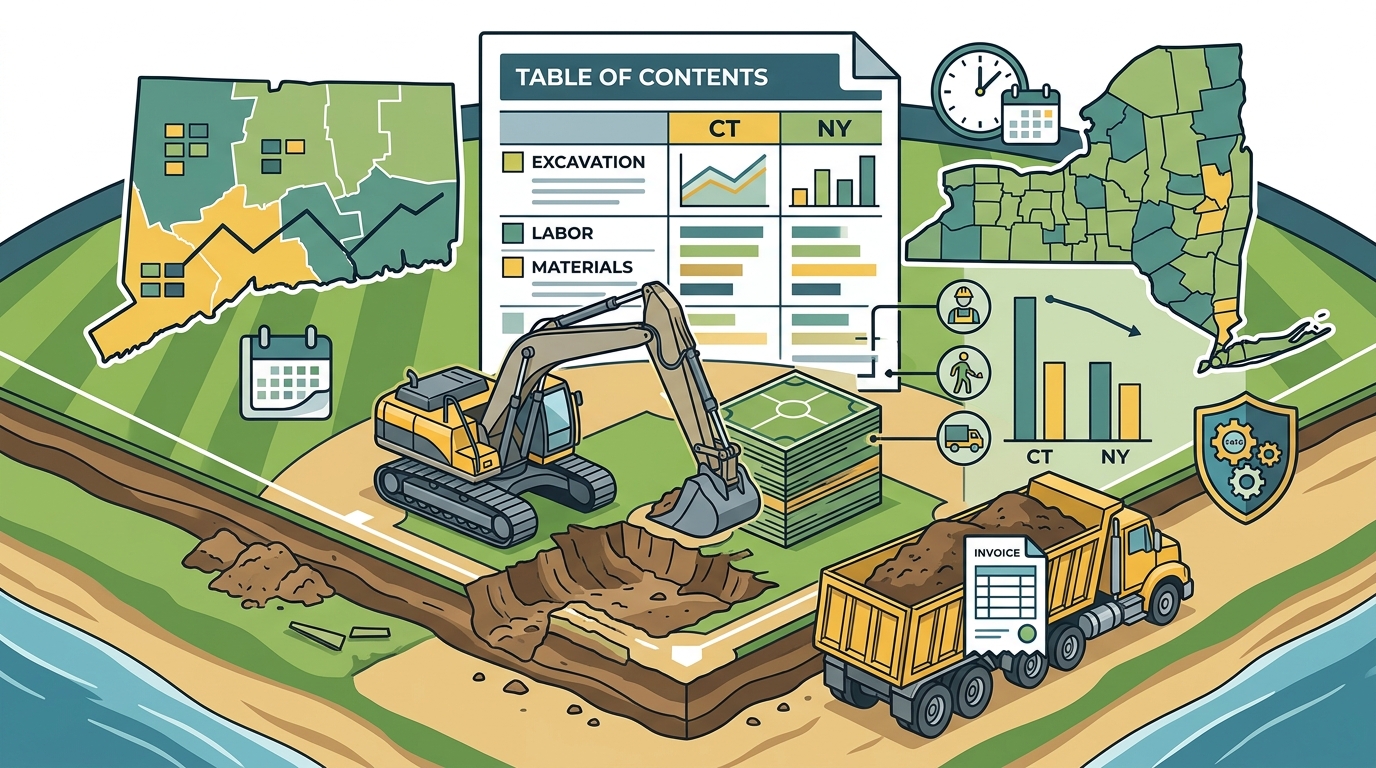
Prevailing wage is a legal requirement that mandates contractors pay workers the standard rates for their specific trade and location. In Connecticut and New York, public works projects must adhere to strict wage determinations issued by state labor departments. These rates are updated annually and vary by county, meaning a project in Fairfield County, CT, may have different labor costs than one in Westchester County, NY.
Impact on Labor Costs
Labor typically accounts for 40% to 60% of total excavation costs. When prevailing wage applies, contractors must pay higher base rates, overtime premiums, and fringe benefits. This significantly increases the per-hour cost of operating heavy equipment. For athletic field projects involving municipal schools or public parks, these requirements are non-negotiable and must be factored into every bid.
Documentation and Compliance
Contractors must maintain detailed payroll records and submit certified payroll reports. Failure to comply can result in penalties, stop-work orders, or disqualification from future bids. Greenway Athletic Field Services ensures full compliance with state labor laws, providing clients with transparent cost structures that reflect these legal mandates. Understanding these requirements helps facility owners anticipate budget variances between public and private projects.
Rock Excavation Premiums
Rock excavation is the process of removing bedrock or hardpan soil from a site, which requires specialized equipment and techniques. Unlike standard soil, rock cannot be moved with standard excavators alone. It often requires hydraulic breakers, drilling and blasting, or heavy-duty ripping. This complexity drives up costs significantly compared to loose earth removal.
Cost Factors for Rock Removal
Site-Specific Variables
The topography of the site and the presence of utilities also affect rock removal costs. Steeper slopes require more careful grading and shoring, increasing labor time. Proximity to existing structures may limit the use of heavy machinery, necessitating manual labor or smaller equipment. Greenway Athletic Field Services conducts thorough site assessments to identify rock layers early, allowing for accurate budgeting and efficient execution. This proactive approach prevents costly surprises during the construction phase.
| Excavation Type | Typical Cost Range (Per Cubic Yard) | Primary Cost Drivers |
|---|---|---|
| Prevailing Wage Labor Premium | 15% - 30% increase | Higher base wages, fringe benefits, compliance |
Key Takeaways
- Rock excavation premiums can double or triple the cost of standard soil removal.
- Prevailing wage requirements apply to public works projects and increase labor costs by 15% to 30%.
- Site-specific factors like rock type, depth, and topography significantly impact final pricing.
- Early site assessment helps identify rock layers and prevents budget overruns.
- Compliance with state labor laws is mandatory for municipal athletic field projects.
- Specialized equipment like hydraulic breakers and drilling rigs is required for hard rock removal.
- Transparent cost structures from experienced contractors ensure accurate budgeting.
Frequently Asked Questions
What is the average cost of athletic field excavation in Connecticut?
How does prevailing wage affect my project budget?
Prevailing wage mandates higher base pay and fringe benefits for workers on public works projects. This increases the per-hour cost of labor, which can raise total excavation costs by 15% to 30%. Contractors must submit certified payroll reports to ensure compliance, adding administrative overhead to the project.
What is rock excavation and why is it more expensive?
Do private athletic field projects require prevailing wage compliance?
Generally, prevailing wage requirements apply to public works projects funded by government entities. Private projects may not be subject to these mandates unless specified in the contract. However, some private developers choose to comply to ensure fair labor practices and avoid potential disputes.
How can I reduce excavation costs for my athletic field?
Conducting a thorough site assessment early in the planning phase helps identify rock layers and soil conditions. This allows for accurate budgeting and prevents costly surprises. Choosing a contractor with experience in the local geology can also optimize equipment selection and reduce cycle times.
What factors influence the cost of rock removal in New York?
The cost of rock removal in New York is influenced by the type of rock, its depth, and the volume required for removal. Granite and basalt are common in the region and are harder to break than limestone. Proximity to existing structures and utilities may also limit equipment options, increasing labor costs.
How long does rock excavation take compared to soil removal?
Rock excavation takes significantly longer than soil removal due to the slower cycle times required to break hard rock. A standard excavator can move soil much faster than it can break rock. This extended timeline can impact overall project schedules and should be factored into planning.
Who should I contact for athletic field excavation in CT and NY?
Greenway Athletic Field Services specializes in athletic field construction and maintenance in the Connecticut and New York region. They provide comprehensive solutions for site preparation, including excavation and grading. To plan your visit, .
Conclusion
Understanding the costs of athletic field excavation in Connecticut and New York requires careful consideration of prevailing wage requirements and rock excavation premiums. These factors can significantly impact your budget, but with proper planning and a knowledgeable contractor, you can achieve accurate cost estimates. Greenway Athletic Field Services brings over 135 years of combined experience to every project, ensuring that your athletic field is built on a solid foundation. For more information on our services, visit our home page or about page.